Homemade cooking definition: the law, the logo and what a restaurant menu really says
“Fait maison” appears on every chalkboard. In France it is a legal term since 2014, with a logo, display rules and inspections. Here is how to read a menu, dish by dish.

- In France, “fait maison” is regulated by the Hamon law of 17 March 2014 and the decree of 11 July 2014, amended on 6 May 2015.
- A homemade dish is prepared on site from raw produce; some prior operations (cutting, freezing, vacuum-packing, peeling except potatoes) are allowed.
- The law works dish by dish: a menu may legally mix homemade dishes, marked with a logo, and others that are not.
- The DGCCRF enforces the rules; a false claim can be prosecuted as a misleading commercial practice.
“Homemade”: everywhere on menus, precisely defined by law
“Fait maison” reassures diners, but it is not a free promise: since 2014 French law defines it, with a logo, display rules and inspections — applied to each dish, not to the restaurant as a whole.
We cover the legal texts, the logo, the neighbouring labels, and how to read a menu.
A legal label, not a slogan.

What the law says: the official definition of “homemade”
The label comes from a law passed by Parliament, then detailed by decree.
The Hamon law and its decrees
Law no. 2014-344 of 17 March 2014 requires restaurants to state which dishes are homemade. Decree no. 2014-797 of 11 July 2014, amended by decree no. 2015-505 of 6 May 2015, sets the details; the rules now sit in the Consumer Code (art. L. 122-19 ff. and D. 122-1 ff.).
Sources: Légifrance and the DGCCRF “Fait maison” guidance. Always check the version in force.
Prepared on site, from raw produce
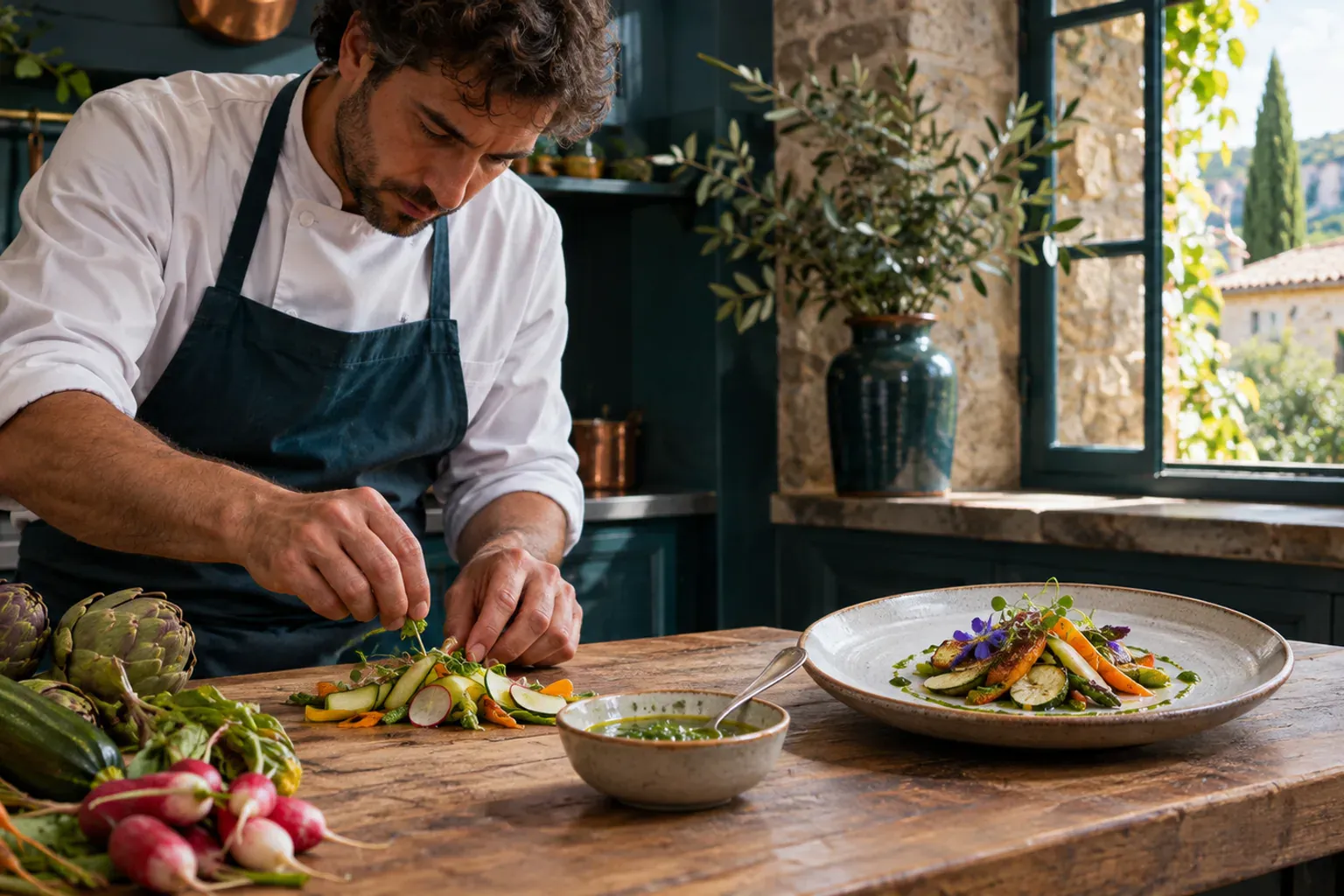
A homemade dish is prepared on the premises from raw produce: food that is raw or has undergone no significant change, including by heating, marinating or assembling.
- Peeling (except potatoes)
- Cutting, chopping
- Refrigeration, vacuum-packing
- Freezing, thawing
Note the exception: potatoes must be peeled on site.
Products a cook may buy in
The regulation lists products that can go into a homemade dish without being made on site.
Cured meats
Except terrines and pâtés.
Dairy, bread, pasta
Cheese, butter, cream, milk; bread, flour, dried pasta and cereals.
Pantry and stocks
Spices, condiments, chocolate, coffee; stocks and fumets; wines and spirits.
Summary only: the exact wording is in the Consumer Code (art. D. 122-1 ff.) on Légifrance.
Special cases
Caterers and markets
A dish made in the caterer's or trader's own premises can qualify.
Frozen produce
Frozen raw produce cooked on site can qualify; a frozen ready meal reheated never does.
The “homemade” logo and menu labelling
The rules provide a shared visual sign and display requirements.
A saucepan topped with a roof
Set by an order of 11 July 2014, the logo sits next to each dish concerned, with an explanatory sentence visible on the menu.
Dish by dish: the key to reading a menu
The law doesn't label a restaurant. It labels a dish.
A menu may legally mix homemade dishes and bought-in ones. A missing logo isn't a confession — it's information.
Who checks?
The DGCCRF and its local services. Breaches can lead to an administrative fine; a false claim can be prosecuted as a misleading practice.
Homemade, “cooked on site”, “fresh”, “artisan”: don't mix them up
Not all menu words carry the same weight.
| Label | What it guarantees | What it doesn't |
|---|---|---|
| Homemade (logo) | Prepared on site from raw produce, legally defined. | Local or seasonal origin. |
| Fresh / local produce | An intention of freshness or proximity. | On-site preparation; no legal restaurant definition. |
| Maître restaurateur | A state-issued title after an independent audit. | That every dish is homemade. |
Local produce and homemade cooking complement each other — see our page on cooking with local produce.
Why not everything can (or should) be homemade
A small kitchen has to choose where to spend its time.
Time
A small team focuses on its signature dishes.
Neighbouring craftspeople
Bakers, cheesemakers and butchers do their trades best.
Homemade is a method, not an absolute.
Transparency beats slogans
An honest restaurant says what it makes itself, dish by dish.
The same spirit runs through Provençal specialities.
Reading a menu when choosing a restaurant
A few questions and a careful look are enough.
Questions to ask
- “Which dishes are homemade today?”
- “Is this dessert yours or an artisan's?”
Clues on the menu
The logo, dish by dish
A sign of a precise approach.
A short, changing menu
It follows what arrives in the kitchen.
To see raw produce before it reaches the kitchen, stroll through the Lorgues market.

In Lorgues: how Carnets de Voyage approaches homemade cooking
France & World fusion cuisine with a good share of homemade, cooked on site in a Provençal house dating from 1780.
The menu changes weekly with chef Benjamin — our menu that changes every week.
A concrete example: our homemade fries. We say it for that dish because it's true.
Curious about the word fusion? Read our fusion cuisine definition.
More on our homemade restaurant in Lorgues.
We cook on site, dish by dish.
Your questions on the homemade definition
Is the homemade logo compulsory?
No restaurant has to cook homemade, but one that claims it must follow the official labelling rules.
Can a frozen dish be homemade?
Frozen raw produce cooked on site can be; a frozen ready meal reheated cannot.
Can fries be “homemade”?
Yes, if made on site from potatoes peeled in the kitchen.
How does it differ from “maître restaurateur”?
Homemade labels a dish; maître restaurateur is a state title awarded to an establishment.
Must the bread be made on site for a dish to be homemade?
No. Bread is among the products the rules allow to be bought in.
Who checks the homemade label?
The DGCCRF and its local services.
Fancy tasting this week's menu?
Book by phone on 07 88 88 89 60. We'll gladly tell you, dish by dish, what comes out of our kitchen this week.
Carnets de Voyage · 12 avenue Allongue, 83510 Lorgues